


Latest MIBI research shows level of uninsured private vehicles increased last year
Approximately 211k uninsured or unregistered vehicles on Irish roads in 2025
1 in every 15 vehicles on Irish roads uninsured or unregistered
New proposed system would make identifying uninsured vehicles administration led rather than policing led
The Motor Insurers’ Bureau of Ireland (MIBI) has called for the introduction of Continuous Vehicle Coverage (CVC) in Ireland to help reduce the number of uninsured vehicles on Irish roads. CVC is an enforcement system which moves the detection of uninsured vehicles from being policing led to being administration led.
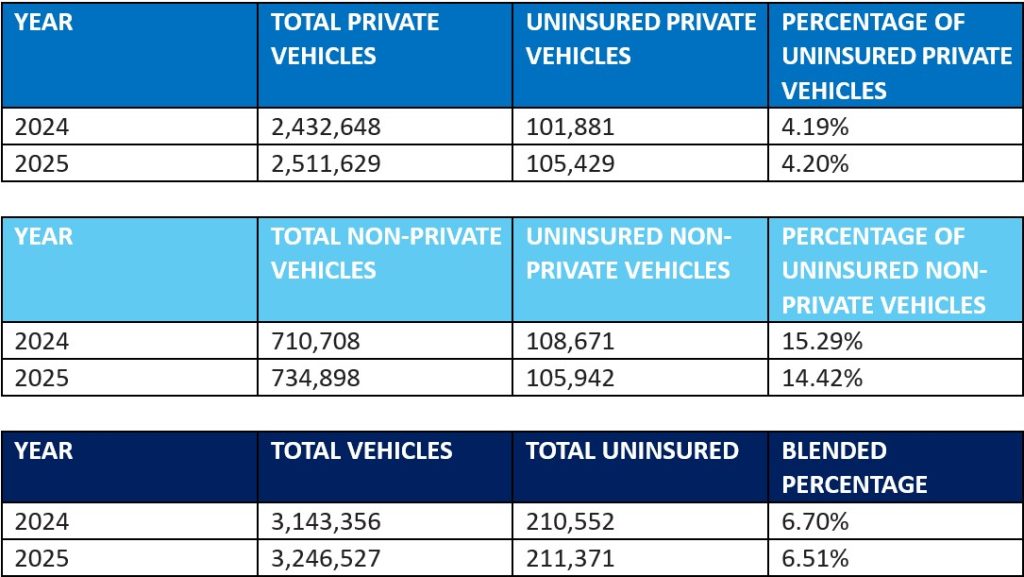
This follows the MIBI’s latest research into the level of uninsured vehicles on Irish roads. At the end of last year there was a total of 211,371 uninsured or unregistered vehicles operating in this country, which represents approximately 6.5% of the vehicle fleet. That correlates to approximately 1 in every 15 vehicles using our roads.
This includes a total of 105,429 uninsured private vehicles in 2025, compared with 101,881 in 2024. That is 3,548 more uninsured private vehicles than had been operating the year before, which represents a 3.5% increase on that figure.
Following the introduction of the Irish Motor Insurance Database (IMID) in 2024, the MIBI can now also undertake an analysis of ‘non private’ motor vehicles. Some of these are insured on an individualised basis, while others use flexible, fleet or motor trader policies, which allow the policy to be transferred from one vehicle to another within a specific group of vehicles. Under law, the insurance details for these vehicles are required to be added to the National Fleet Database (NFD), a specialised subsection of IMID.
A total of 105,942 of ’non private’ vehicles remain either uninsured or are not yet registered on NFD.
The MIBI believes these uninsured numbers could be significantly reduced if a Continuous Vehicle Coverage model was introduced. Such a system is already being used in 25 European countries, including the UK, France, Germany, Belgium, Netherlands, Norway, Sweden, Denmark and many more.
It has proven very effective in the UK, where the number of uninsured vehicles dropped from approximately 6% to 2.5%, following its introduction.
The increase in the level of uninsured vehicles comes despite extensive Garda activity around uninsured driving last year. A total of 19,673 vehicles were seized for driving without insurance in 2025 and a further 25,009 charges and summons were issued for that offence over the same period.
Currently in Ireland, someone is only penalised if they drive a vehicle without valid insurance. This puts all the pressure on identifying and apprehending the uninsured on An Garda Síochána. Under CVC a different approach is used, which moves the focus from apprehending those driving an uninsured vehicle, to requiring motor insurance based on the ownership of road vehicles.
Through this system, the owner is legally required to insure their road vehicle at all times once they take ownership. Registered vehicles are compared with insured vehicles, allowing any that are uninsured to be easily identified. Fines are then issued where there is a mismatch, i.e. if the vehicle is registered but not insured.
In the UK’s system, notice of fines are issued to vehicles who have been uninsured for 28 days. If the insurance status is not changed after 56 days then a Fixed Charge Notice is issued to the owner. Only after there has been no response from the owner for a period of 182 days is the matter referred to the police, who will pursue a prosecution.
This approach changes the focus on tackling those breaking the law and operating without insurance from being a policing led model to becoming an administration led model.
The MIBI is a not for profit organisation that was established to compensate victims of road traffic accidents caused by uninsured and unidentified vehicles.
“Ireland still has a very high level of uninsured vehicles on our roads,” said David Fitzgerald, CEO of the MIBI. “This is despite the strong and effective work of An Garda Síochána in policing uninsured driving, and the success the IMID system has had in helping them identify those offenders who are breaking the law.
“However, the latest analysis of uninsured activity shows there has actually been an increase in the number of uninsured private vehicles operating on our roads. 1 in every 15 vehicles is either uninsured or unregistered. Progress is flatlining and further measures are required.
“That’s what Continuous Vehicle Coverage would provide. It would reduce the pressure on the Gardaí and make enforcement against uninsured vehicles an administration led process first. Under this system, unless the vehicle is formally put off the road, then the vehicle owner must ensure it is insured, rather than requiring the Gardaí to catch an uninsured driver in the act.
“This approach is what is used by the vast majority of our European counterparts and it is one that we are finally in a position to introduce in this country following the development of IMID. Adapting our system to this approach would have benefits for the Government, An Garda Síochána, insurance providers and road users. It would enhance road safety and also help address cost pressures associated with uninsured driving.
“If this country is serious about reducing illegal, uninsured activity on our roads, then the MIBI believes this approach is essential. It is the most realistic way for Ireland to address the considerable number of uninsured vehicles and to finally achieve levels similar to our European counterparts,” Mr. Fitzgerald concluded.